New publication from Eisenhauer et al in Nature Reviews Biodiversity: Soil biodiversity effects on ecosystems
Soil biodiversity is a key driver of ecosystem function, including nutrient cycling, organic-matter decomposition, plant productivity, climate regulation and pathogen control (with subsequent effects on animal, human and plant health). A foundational review in 2014 described the functional role of soil biodiversity in ecosystems, but our understanding of the relationship between soil biodiversity and ecosystem functioning has deepened over the past decade. In this Review, we highlight progress in the field, discuss the approaches and methodological advances that have enabled this progress, and identify emerging research questions. Although the spatiotemporal patterns and community dynamics of soil communities are becoming well understood, topics with important knowledge gaps include the climate feedback effects of soils, the ecology of urban soils and the development of soil health indicators. Global collaborative networks, linking existing databases, and monitoring soil biodiversity and ecosystem functioning are important ways to address these knowledge gaps. By considering the relationships between soil biodiversity and ecosystem functioning we can connect small-scale interactions among plants, microorganisms and animals to ecosystem services and planetary sustainability.
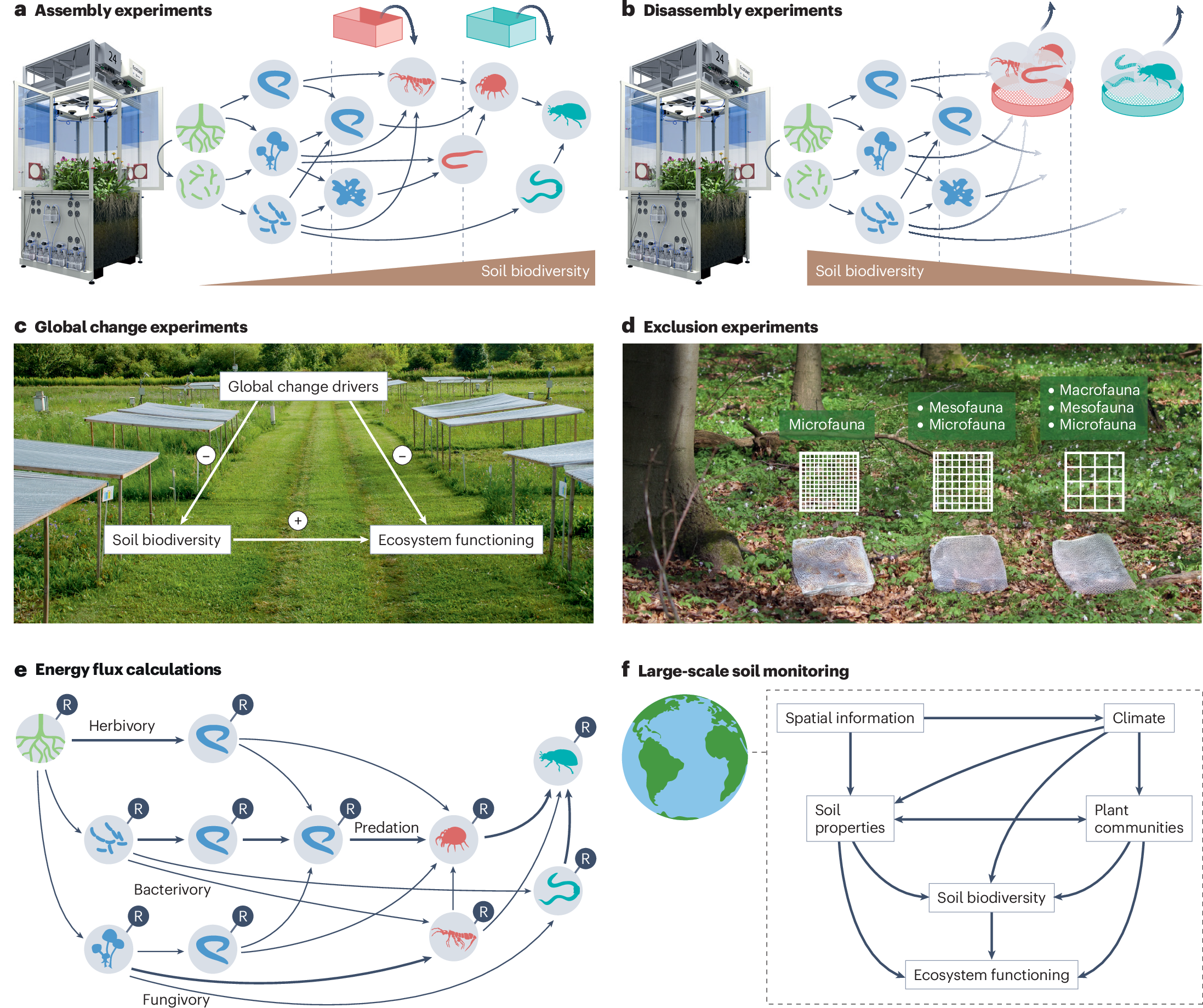
a, Assembly experiments to investigate the relationships between soil biodiversity and ecosystem functioning (BEF) manipulate the composition of soil communities (for example, by adding specific taxa or functional groups) to examine how community assembly influences ecosystem processes. b, Soil BEF disassembly experiments, including dilution-to-extinction or sieving approaches, systematically reduce community complexity to identify the thresholds and functional contributions of specific groups. In parts a and b, the Ecotron images (left) illustrate one possible setup for controlled global-change experiments, but these approaches are also widely conducted in field settings. Ecotrons are controlled experimental facilities that simulate natural ecosystems to study how they respond to environmental changes. Similar, but probably less close-to-nature, experiments could also be performed in other microcosms or mesocosms in climate or greenhouse chambers. c, Global change experiments quantify joint responses of soil biodiversity and ecosystem functions (for example, to drought or warming) and synthesize these relationships with structural equation models. These experiments can be conducted in the field or in controlled environments such as Ecotrons. d, Field exclusion experiments remove specific soil organism groups or body-size classes using mesh bags or targeted pesticide applications in order to quantify their functional roles by excluding them. e, Energy-flux studies trace energy flow through soil food webs using stable isotopes, fatty-acid biomarkers or other biochemical tracers. R, respiration. f, Regional-to-global soil BEF surveys combine existing databases with new sampling efforts and apply structural equation modelling to infer large-scale BEF relationships. Photograph credits: panels a and b, Kimberly Falk; panel c, Anja Vogel; panel d, Stefan Bernhardt.
Reference:
Eisenhauer, N., M. Sünnemann, M. M. Pollierer, X. Sun, R. D. Bardgett, et al. 2026. Soil biodiversity effects on ecosystems. Nature Reviews Biodiversity:1–16. https://doi.org/10.1038/s44358-025-00123-z.